NAPOLEON (2023)

A look at the military commander's origins and his swift, ruthless climb to emperor, viewed through the prism of his addictive and often volatile relationship with his wife and one true love, Josephine. 

In Ridley Scott's newest film, Napoleon, the acclaimed director takes us on a sweeping journey through ambition, power, and love amid historical chaos. Joaquin Phoenix stars as the iconic Emperor, and Vanessa Kirby portrays his mysterious love interest, Josephine. The movie unfolds as an epic tale of Napoleon Bonaparte's rise and fall, blending intense scenes with moments of lighthearted humour.

Remaining true to Ridley Scott's distinctive style, Napoleon embraces a grand scale with careful craftsmanship and lavish set designs. The film's ambitious vision is evident in its captivating battle sequences, showcasing Scott's skill in creating visually stunning depictions of historical conflicts, from the Battle of Austerlitz to the clash at Toulon.


Joaquin Phoenix's performance as Napoleon is nuanced, drawing comparisons to his previous roles in Joker and Gladiator. He skillfully navigates the complexities of Napoleon's character, portraying a man who is both confident and deeply insecure. The film allows Phoenix to paint a multifaceted portrait of Napoleon, exploring his interactions with peers, rivals, and the tumultuous relationship with Josephine.

Napoleon takes a unique narrative approach by telling the entire nation's story through the lens of marriage. The film delves into the mental and sexual dynamics between Napoleon and Josephine, revealing a tumultuous romance marked by manipulation, humiliation, and infidelity. Vanessa Kirby's portrayal of Josephine adds depth, depicting her as a woman engaged in a prolonged battle of wills with Napoleon.


A noteworthy aspect of Napoleon is its ability to balance tones, seamlessly shifting between gruesome war scenes and moments of playful humour. This dynamic adds layers to the narrative, preventing it from becoming a typical historical epic and humanizing the iconic figure of Napoleon Bonaparte.

At the movie's core is the tumultuous relationship between Napoleon and Josephine, exploring a love that defies convention and power dynamics in post-revolution France. Josephine's open engagement in extramarital affairs creates a complex dynamic that alternately nurtures and humiliates Napoleon. The film dedicates its 158-minute runtime to unravelling how Napoleon's unchecked insecurity shapes both his personal life and the course of history.


While Napoleon excels in large-scale battle sequences, it grapples with narrative cohesion during dialogue-driven scenes. The film occasionally teeters between serious drama and campy satire, leaving the audience uncertain of its intended tone. Despite these challenges, the exploration of Napoleon's character, from a toxic dictator to a vulnerable lover, introduces intriguing ideas that contribute to the film's overall complexity.

Joaquin Phoenix's performance captures Napoleon's contradictions – a leader with vaulting ambition and unchecked power, yet plagued by insecurities. The film delves into Napoleon's mind, portraying his vulnerability and the guardedness surrounding it. Phoenix adeptly contrasts Napoleon's public-facing confidence with the private struggles that define his character.


Amid grand battles and political intrigues, the heart of Napoleon lies in the relationship between Napoleon and Josephine. Vanessa Kirby's portrayal of Josephine, a woman who simultaneously respects, fears, and manipulates Napoleon, adds depth to the narrative. The film's occasional choppiness finds solace in scenes focused on the central relationship, providing a respite from the otherwise brisk pace.

Beyond depicting Napoleon's military achievements and political manoeuvres, Napoleon serves as a character study, inviting viewers to reflect on the broader frailties of humankind. The film explores Napoleon's rise from a Corsican outsider to an exalted emperor and, ultimately, a defeated exile. Ingeniously using domestic life to expand the viewer's understanding of him as a man, the movie emphasizes universal themes of love, ambition, and the consequences of unchecked power.


Napoleon stands out as a cinematic triumph, boldly exploring the complexities of its titular character. The film's grand scale, impressive battle sequences, and the compelling performances of Joaquin Phoenix and Vanessa Kirby elevate it to a noteworthy historical epic. Despite grappling with narrative cohesion and tonal shifts, Napoleon successfully delivers a multifaceted portrait of Napoleon Bonaparte, shedding light on the personal struggles that shaped the destiny of both a man and a nation.

Napoleon will be in cinemas from November 23, 2023

THANKSGIVING (2023)

An axe-wielding maniac terrorizes residents of Plymouth, Mass., after a Black Friday riot ends in tragedy. Picking off victims one by one, the seemingly random revenge killings soon become part of a larger, sinister plan.

Directed by Eli Roth and scripted by Jeff Rendell and Roth himself Thanksgiving breaks away from the Halloween-centric horror trend, presenting a Kiwi audience with a cast featuring Rick Hoffman, Gina Gershon, and Patrick Dempsey. The film injects a dose of horror into the Thanksgiving holiday, embracing shocks and thrills over conventional scares. 

Thanksgiving courageously steps into the spotlight, steering away from the Halloween-dominated horror scene. It takes inspiration from the Scream franchise, prioritizing shocks and thrills.


The story kicks off in Plymouth, Massachusetts, with a prologue that sets the scene for a revenge-seeking killer clad in pilgrim garb and a plastic John Carver mask. A year after a tragic Black Friday incident, this mysterious murderer embarks on a spree, concocting inventive and grotesque demise. 

Thanksgiving doesn't shy away from gratuitous violence, delivering an unrelenting display of gore and blood, reminiscent of the Saw and Hostel franchises. The film's brutality is a spectacle, featuring practical effects that showcase stomach-ripping and face-splitting moments that are both imaginative and cringe-worthy.


While the mystery isn't overly intricate, Roth defies expectations by infusing self-aware humour and unexpected twists into the narrative. The characters, although stereotypical and irritating, serve as victims, keeping the audience on edge as they face the killer's wrath. 

Thanksgiving emerges as a clever and humorous critique of American consumerism, using the holiday season as a backdrop to explore the darker side of greed. Roth's screenplay, co-written with Jeff Rendell, cleverly weaves satire into the fabric of the horror, ensuring the film doesn't take itself too seriously.


The standout feature of Thanksgiving is its gore. The killings, executed with gleeful practical effects, showcase a level of inventiveness that sets the film apart. From eye-averting gore to axe beheadings, the movie caters to those who relish the visceral elements of horror. 

Roth's distinctive style, blending humour and exaggerated gore, provides an unexpected rhythm to Thanksgiving. The film fluctuates between a brutal first act, a relatively tamer second act, and a high-octane, gory main course. The kills, both gut-busting and gut-wrenching, keep the audience engaged.


The characters in Thanksgiving are a mix of obnoxious caricatures, intentionally crafted to be unlikable. Roth and Rendell's script makes a bold choice by not aiming for sympathy, allowing the maniacal serial killer to take centre stage without reservations. 

Unapologetically indulging in R-rated content, Thanksgiving pushes the boundaries of what the genre allows. Roth's direction takes the film to the edge, delivering a level of nastiness that horror enthusiasts crave.


While the script follows a straightforward path, it takes a backseat to the real stars of the show—the kills. Thanksgiving prioritizes its gruesome spectacle over intricate storytelling, offering a feast for fans of eye-popping horror.

Thanksgiving, under Eli Roth's direction, carves its niche in the horror landscape. It's not a flawless film, but it doesn't strive to be. Instead, it revels in its imperfections, delivering a visceral and satirical experience that leaves an indelible mark on the Thanksgiving horror subgenre.

Thanksgiving is in cinemas from November 16, 2023

SEVEN PSYCHOPATHS (2012)

Billy wants to help his friend Marty find inspiration and complete a script. He kidnaps a shih tzu that belongs to a gangster who has no qualms about killing anyone to get back his dog.

In 2012, director and writer Martin McDonagh brought us Seven Psychopaths, a film that takes us on a wild and self-aware journey through Hollywood's underbelly. Starring Colin Farrell, Woody Harrelson, Sam Rockwell, and Christopher Walken, this darkly humorous tale weaves together elements of crime, violence, and absurdity. Set against the backdrop of the City of Angels, McDonagh's creation is an exploration of the fine line between snark and satirical wit, all while serving as a commentary on violence and peace in the world of movies.


The film revolves around Marty (Colin Farrell), an aspiring scriptwriter in Hollywood, who, in reality, hasn't progressed much beyond the title of his screenplay, "Seven Psychopaths." Marty's mundane life takes a wild turn when his best friend, Billy (Sam Rockwell), inadvertently dognaps the cherished shih tzu of a ruthless gangster, Charlie (Woody Harrelson). This sets off a chain of events that entangles them with a host of eccentric characters and some truly deranged individuals.

Colin Farrell's portrayal of Marty is a refreshing departure from his previous roles, embracing the character of an Irish waster. Christopher Walken, as Marty's elderly accomplice Hans, brings depth and intrigue to his character with his distinctive delivery and demeanour. Meanwhile, Woody Harrelson is convincingly menacing as Charlie, providing the necessary edge to the story.


Seven Psychopaths delves into a dark and violent world, but it does so with a unique sense of humour that permeates even the most gruesome moments. McDonagh skillfully balances humour, violence, and absurdity, creating a plot that keeps the audience engaged throughout. The film's self-awareness is a striking feature, with the characters themselves openly critiquing the movie as it unfolds, drawing inspiration from the works of Samuel Beckett.

One of the film's standout elements is its witty dialogue, which is laced with humour. The characters engage in deconstructions of famous sayings, surreal script ideas, and humorous confrontations. McDonagh's ability to craft funny dialogue for these small-time criminals adds depth to their characters and amplifies the comedic aspect of the story.


Seven Psychopaths is a cinematic experience that can be likened to Quentin Tarantino's work, particularly in the opening scenes. However, to merely label it as a Tarantino imitation would be an injustice to McDonagh's own unique voice. The dialogue, for the most part, is dry and well-constructed, providing a fresh perspective on the crime-comedy genre.

The film also engages in meta-commentary on the art of filmmaking, weaving questions about the meaning of life and the human need for dreams into its narrative. It prompts viewers to ponder whether our actions in life hold significance, or if we are merely characters in someone else's story. This thematic depth adds an extra layer of intrigue to the film.


Despite its occasional snarky tone, Seven Psychopaths is a highly entertaining movie. It captivates audiences with its unconventional characters, dark humour, and moments of violence. While it may not leave a lasting impact like some of its contemporaries, it stands as a unique addition to the world of crime-comedy cinema.

Seven Psychopaths offers a rollercoaster of absurdity, violence, and wit. With a top-notch cast and a story that keeps you guessing, it's a film that leaves you entertained and contemplating the meaning of life and storytelling. It may not be a perfect cinematic masterpiece, but it is undeniably a memorable and engaging experience.

THE FALL OF THE HOUSE OF USHER (2023)

Siblings Roderick and Madeline Usher have built a pharmaceutical company into an empire of wealth, privilege and power; however, secrets come to light when the heirs to the Usher dynasty start dying.

Netflix's The Fall of the House of Usher is a television series created by Mike Flanagan and features a cast that includes Bruce Greenwood, Carla Gugino, Mary McDonnell, Carl Lumbly, and Mark Hamill. This adaptation is loosely based on Edgar Allan Poe's short story of the same name. The show unfolds a chilling tale of a pharmaceutical industry magnate, Roderick Usher, who watches his offspring meet gruesome ends during the twilight of his empire. Over the course of its eight episodes, Flanagan crafts a sort of Poe Cinematic Universe, drawing inspiration from Poe's most famous works and weaving them into an original narrative of greed and familial disintegration.

However, The Fall of the House of Usher exhibits a disconcerting discord between its subject matter and its emotional tone. Despite sporadic moments of intrigue, the series lacks the central element found in Poe's works: passion. The characters in Usher may be meeting their fates like characters in a gothic horror tale, but they fail to live with the fervour that such a setting demands.


Mike Flanagan, known for his fondness for jump scares, introspective monologues, and a keen interest in exploring family dynamics, brings these themes to the forefront in this adaptation. Flanagan's perspective suggests that, even in the face of cynicism, there is always hope for family reconciliation or redemption.

The grim deaths of the Usher family members are portrayed as supernatural retribution for their role in America's opioid crisis, which they directly contributed to. While the series references numerous works by Poe, they often serve as mere Easter eggs, failing to enhance the main storyline. Furthermore, the primary narrative suffers from a disconnect between the stories it draws from and the actual direction of the plot.


Even when characters are succumbing to delusions or meeting their demise, the series maintains a detached tonal approach, as if we are observing human suffering from an indifferent corporate tower, much like Roderick Usher himself. While there are elements of horror in The Fall of the House of Usher that are skillfully executed, the series becomes overwhelmed by its inconsistent handling of source material, which might not have been necessary in the first place.

The show's narrative becomes convoluted with flashbacks, subplots, and diversions, to the point where a flow chart would be helpful in navigating it. The overarching story revolves around the impending, bizarre deaths of Usher's reprehensible heirs within a month's time, all connected by a mysterious woman played by Carla Gugino, who serves as an angel of death.


Unlike Flanagan's previous works like The Haunting of Hill House and The Haunting of Bly Manor, The Fall of the House of Usher fails to evoke fear, and this lack of emotional connection permeates the series. The narrative is predominantly retrospective, with the consequences already unveiled, making it challenging to connect with the characters.

The series takes inspiration from various Poe works such as The Fall of the House of Usher, "The Masque of the Red Death," "The Murders in the Rue Morgue," "The Black Cat," "The Tell-Tale Heart," "The Gold Bug," "The Pit and the Pendulum," and the poem "The Raven." These gruesome events are attributed to the karmic revenge of a shape-shifting spectral character named Verna, an anagram of "raven".


Despite the consistency and competence in storytelling, the series' pacing is a significant drawback, particularly in the lengthy flashbacks that reveal the origins of the Usher twins' torment. The revelation may leave the audience somewhat disappointed, as there is still a substantial amount of wrap-up that includes a series of monologues.

Flanagan has transformed stories that fundamentally explore the horror of loneliness into platforms for melodramatic family dynamics. While there are few scares in The Fall of the House of Usher, they often take the form of eerie apparitions suddenly appearing to terrify Roderick Usher.


The initial episode establishes an intriguing narrative, but subsequent episodes follow a formulaic structure. Each episode delves into a different Usher descendant's inner life and the gradual intrusion of a mysterious woman named Verna, leading to their eventual demise. Unfortunately, the characters fail to engage the audience effectively.

The series suffers from predictability and mundanity, which is unexpected, especially given Flanagan's reputation for crafting unconventional narratives. Each episode sets the stage for the downfall of a beneficiary of the ruthless Usher empire, with Roderick recounting the stories of their catastrophic ends. This predictability diminishes the sense of dread.


Although the series contains bursts of gruesomeness, they are insufficient to evoke the melancholic dread typically associated with Poe's works. The series is inundated with an abundance of monologues, all presented in a similar fashion, which becomes tiresome.

In conclusion, The Fall of the House of Usher attempts to amalgamate various elements of Poe's works into a contemporary narrative. While it boasts moments of effective horror and is competent in its execution, the series struggles with tonal inconsistency and a narrative structure that becomes formulaic and repetitive. The emotional depth and connection with the characters are lacking, ultimately leaving the viewer with a sense of detachment. Despite its thematic ambitions, the series fails to fully capture the essence of Edgar Allan Poe's storytelling, resulting in a work that, while intriguing at times, falls short of its potential.

The Fall of the House of Usher was released on Netflix on October 12, 2023

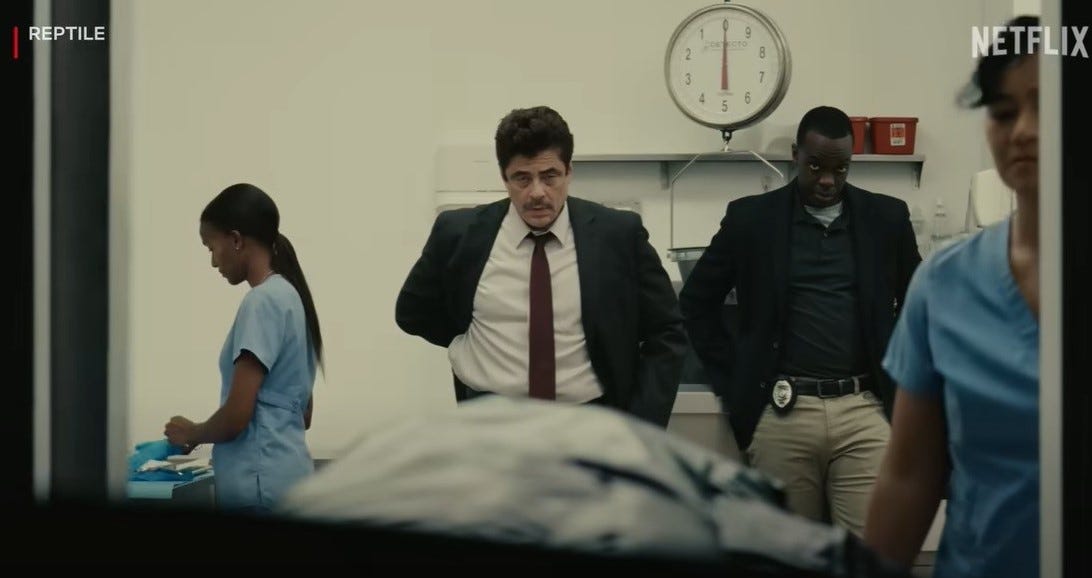
REPTILE (2023)

Following the brutal murder of a young real estate agent, a hardened detective attempts to uncover the truth in a case where nothing is as it seems, and, by doing so, dismantles the illusions in his own life.

Reptile, directed by Grant Singer and headlined by the formidable Benicio Del Toro, embarks on a suspenseful journey that initially teases the idyllic facade of suburban life. However, as the plot unfolds, it delves into a world of mystery, mistrust, and danger, although not without its flaws. The film opens with a picturesque portrayal of American middle and upper-class life, featuring grand white houses symbolizing the allure of prosperity. However, this illusion of affluence is quickly shattered by a shocking murder, setting the stage for a dark and gripping detective drama.


At the heart of the investigation is Tom Nichols, portrayed by Benicio Del Toro. Tom stands out as a well-adjusted movie cop, a rarity in the genre. His interactions with his wife Judy, played by Alicia Silverstone, and his colleagues appear harmonious. This suburban setting, captured visually by cinematographer Mike Gioulakis, serves as a contrasting backdrop to the impending chaos.

However, Reptile fails to fully exploit the potential of this suburban nightmare. While Tom's character displays eccentricities on the job, he is observant, rule-driven, and straightforward. His personal life, complete with square dancing and poker nights, is enriched by the unwavering support of his intelligent and forthright wife, Judy, and her extended family, which includes his police colleagues.


Despite the all-pervading mood of mistrust that engulfs the film, it remains the singular note, varying in shades of unease. The movie occasionally touches on worthy moments of tension and insight, but the narrative occasionally becomes convoluted and derivative. Benicio Del Toro's mesmerizing and authentic performance elevates Reptile above its occasional shortcomings. His on-screen chemistry with Alicia Silverstone's Judy exudes warmth and passion, with a subtle undercurrent of tension stemming from Tom's jealousy.


Reptile immerses the audience in a world where danger lurks around every corner. The incessant late-night phone calls and unexpected visitors at the door contribute to an atmosphere of constant unease. The film's tension is further heightened by the ever-encroaching headlights in rearview mirrors and an unrelenting sense of impending peril. Jump scares are abundant, and trust is a rare commodity in this enigmatic world.

Every scene is steeped in an aura of mystery, which works to the film's advantage. However, the leisurely pace in the second half of the movie robs viewers of a more intense and engaging experience. The pool of suspects is limited but surprisingly filled with potential psychopaths. One aspect of Reptile that shines is its craftsmanship. Cinematographer Mike Gioulakis masterfully captures the sinister underbelly of suburban life. The polished imagery brings to life the hidden darkness lurking beneath the facade of the seemingly peaceful neighbourhoods.


Yet, it is the performances that truly carry Reptile. Benicio Del Toro, in particular, delivers a nuanced and understated performance that draws the audience in. His ability to convey a myriad of emotions beneath his calm exterior is nothing short of remarkable. He never overplays or falls short of what is required, making his role a standout in the film. Sometimes, a stellar performance can compensate for a less-than-perfect script. Del Toro's portrayal showcases his unparalleled instincts as an actor, with a face that can convey a multitude of emotions beneath the surface.

Director Grant Singer successfully evokes a grimy and noir atmosphere, teeming with tension and suspense. The overcast skies and sinister mood contribute to the film's overall sense of foreboding. However, Reptile truly excels when the camera is focused on Benicio Del Toro, who effortlessly carries the noir-ish procedural thriller on his capable shoulders. On the other hand, Justin Timberlake's performance falls somewhat short of the mark. His portrayal leaves one with the impression that he is trying too hard, failing to match the authenticity and depth of Del Toro's acting.


The first hour of Reptile builds a solid foundation, but as the storyline becomes increasingly convoluted, it loses some of its initial engagement. The mystery's eventual clarity detracts from the suspense and intrigue that the film initially promises.

Reptile is a mixed bag. While it boasts moments of genuine tension, an authentic performance by Benicio Del Toro, and evocative cinematography, it falls short in terms of a convoluted plot and the less convincing performances of certain cast members. Nevertheless, for fans of the noir detective thriller genre, Reptile is worth a watch, if only for the compelling presence of Benicio Del Toro.

Reptile was released on Netflix on September 7, 2023

KILLERS OF THE FLOWER MOON (2023)

In the 1920s, members of the Osage Native American tribe of Osage County, Oklahoma, are murdered after oil is found on their land, and the FBI decides to investigate.

In Martin Scorsese's latest film, Killers of the Flower Moon, audiences are transported to a period in history that's both harrowing and authentic. This extensive Western crime drama delves into the haunting story of the Osage Indian murders in the 1920s, shedding light on a dark chapter in American history. Boasting a stellar cast led by Leonardo DiCaprio and Robert De Niro, this epic clocks in at three and a half hours, providing a thought-provoking exploration of themes like greed, oppression, and justice.


Adapted from David Grann's book, Killers of the Flower Moon immerses us in a world where the Osage Indians in Oklahoma unexpectedly became the wealthiest per capita due to the discovery of oil beneath their reservation. They lived in grandeur, residing in opulent mansions with chandeliers and surrounded by household staff. The film introduces us to the character of Ernest Burkhart, played by Leonardo DiCaprio, a war veteran returning to live with his uncle, William Hale, portrayed by Robert De Niro.

Hale, a cattle rancher with a facade of charm and congeniality, conceals a sinister and insatiable greed. Ernest, in contrast, appears easily manipulated, serving as the perfect pawn in Hale's ambitions. His mission is to court Mollie, a full-blood Osage woman with valuable oil headrights, a character brought to life with magnetic enigma by Lily Gladstone. Despite Mollie's apparent wisdom, she falls under the spell of Ernest's charms and becomes entangled in a twisted love story that leaves the audience with lingering questions.


Killers of the Flower Moon grapples with pacing issues and moments where further context might have been enlightening. However, the film takes advantage of its extended runtime to construct a vivid world that captures the era's opulence and underlying tension. It's not just a story about greed and murder but also a period piece that immerses us in the 1920s, highlighting the stark contrast between wealth and suffering.

One aspect that leaves room for improvement is the depth of context. It would have been informative to understand why the Osage Indians were so accommodating to the white settlers during this time. The complex love story at the film's core, while rooted in reality, might benefit from more elaboration to deeply resonate with the audience.


Killers of the Flower Moon is not a typical thriller; it lacks the suspense of a classic whodunit because the audience knows the identity of the murderers from the beginning. De Niro's portrayal of malevolence lurking in plain sight is menacingly charismatic, and DiCaprio captures Ernest's internal conflict, guilt, and desperation. Lily Gladstone's performance is captivating and enigmatic, mirroring the complexity of her character.

Nevertheless, the film falls short of fully exploring the character of Mollie, a pivotal figure in Osage Indian history. It's a missed opportunity to tell her story more profoundly. Scorsese's cinematic approach is more focused on character and incidents rather than adhering to a conventional narrative structure, which may not cater to everyone's taste.


Killers of the Flower Moon illuminates a forgotten tragedy of American history, exploring themes of oppression, vengeance, and resistance. The film portrays the devastating consequences of greed and prejudice, with a focus on the Osage people's struggle to manage their newfound wealth while enduring discrimination.

Scorsese's visual storytelling is exceptional, capturing the beauty of the American plains and presenting scenes that resemble paintings. The director's choice to prioritize the antagonists over the victims of the crimes may leave some viewers desiring more depth and emotional connection to the core of the story.


Killers of the Flower Moon offers a compelling examination of a tragic chapter in American history. It provides a glimpse into a world of grandeur and suffering, where greed knows no boundaries. With its remarkable cast and a visual approach that showcases the beauty of the era, the film delivers a unique cinematic experience.

While it grapples with pacing issues and a lack of depth in some areas, Killers of the Flower Moon succeeds in shedding light on a forgotten tragedy. It's a story that needs to be told, reminding us of the dark consequences of prejudice, greed, and the quest for justice. This film may not be for everyone, but it is a thought-provoking and visually stunning piece of cinema that deserves your attention.

Killer of the Flower Moon was released in NZ cinemas on October 19, 2023

SAW X (2023)

A sick and desperate John travels to Mexico for a risky and experimental medical procedure in hopes of a miracle cure for his cancer only to discover the entire operation is a scam to defraud the most vulnerable.

Saw X, the latest instalment in the long-running Saw series, takes us on a journey into the depths of John Kramer's character, exploring his struggles and motivations. Positioned between the first and second films in the franchise, this movie attempts to bring a fresh perspective to the series. However, it departs from the familiar formula, and in doing so, it raises some questions about the essence of the Saw franchise.


At nearly two hours in duration, Saw X is the longest entry in the Book of Saw series. Regrettably, the opening half-hour of the film feels agonizingly slow, dwelling on John Kramer's personal misfortunes rather than advancing the plot. This extended exposition may test the patience of viewers who have come to expect the rapid pacing of previous Saw films.

One notable departure in Saw X is its treatment of John Kramer, a character beloved by fans. Instead of portraying him solely as the orchestrator of gruesome games, the film frames him as a tragic figure. This shift in focus alters the essence of the story and makes us see Jigsaw in a new light.


The hallmark of the Saw franchise has always been its intricate storytelling, both in the design of deadly traps and in the moral dilemmas faced by its victims. However, Saw X falls short in this regard. Unlike earlier entries where the complexity and mystery were paramount, this instalment explains everything before the victims are even ensnared. The result is a lack of suspense and intrigue.

Moreover, the film abandons the social commentaries that previous Saw movies have touched upon. Themes like police brutality, tabloid celebrity, and healthcare and housing crises take a backseat, replaced by a straightforward revenge narrative. While the simplicity of the story might make it more accessible, it also robs it of the engaging layers that fans have come to expect.


A significant departure in Saw X is the way it portrays John Kramer as a sympathetic figure. We are given a glimpse into his personal life, his home, and his battle with cancer. When he realizes that his unconventional treatment hasn't saved him, the audience is meant to share in his frustration. This shift turns the movie into a horror-revenge story, where the audience finds themselves unexpectedly cheering for the character they once considered the "bad guy."

However, despite this unique angle, Saw X struggles to deliver a compelling or convincing story. It veers away from the series' usual themes of retribution and salvation, opting instead for a revenge-driven narrative that feels somewhat out of place.


Tobin Bell, who portrays John Kramer, deserves commendation for his efforts in the film. Despite the lacklustre script, he brings a certain depth to his character. Nevertheless, due to the poorly written character, his performance remains somewhat one-dimensional.

Saw X distinguishes itself from its predecessors by changing the formula of constant police investigations and gruesome traps. While this departure from the norm is intriguing, it adversely affects the pacing and thrill of the movie, leaving it feeling somewhat disjointed.


One notable aspect that hinders the overall experience is the mean-spirited tone and unproportional punishment surrounding each trap and its outcomes. While it may be challenging to feel sympathy for the characters caught in these traps, who are profiting from cancer patients, the film's approach detracts from the overall viewing experience.

In conclusion, Saw X attempts to bring a fresh perspective to the Saw series by delving into John Kramer's character and motivations. However, in doing so, it departs from the core themes that made earlier films in the franchise engaging. 


Despite Tobin Bell's commendable efforts, the movie's one-dimensional script and deviation from the usual narrative approach result in a lacklustre instalment that struggles to live up to the legacy of the Saw series. Fans of the franchise may find themselves longing for the complexity and moral dilemmas that have defined previous entries.

Saw X was released in NZ cinemas on September 29, 2023