FOUR KIDS AND IT (2020)

 
Four kids on holiday in Cornwall meet a magical creature on the beach with the power to grant wishes.

One glance at the movie poster for this film and it tells you a lot of what to expect from this flick; something that would easily fall into the same category as The Muppets or Fraggle Rock. Four Kids and It is an adaptation of the 2012 novel, Four Children and It, which in turn is inspired by E. Nesbit's 1902 novel, Five Children and It. Two distinct levels of source material should form a solid foundation for a children's film with a good moral compass. 


The screenplay, which is written by Simon Lewis, is not quite up to scratch, however. If you have read the books, you will be aware that the film is a fair departure from the materials that it is sourced from, which could have been a brilliant case of creating a unique version of the story, but instead forms a flat, lifeless film with little in the way of a cohesive structure. The entire premise of the original story is based around the idea of "being careful what you wish for", with the frivolous dreams of children turning into scary scenarios that teach the children about the consequences of their actions.


In this adaptation, on the other hand, the characters have been rewritten to include two broken families meeting for the first time, and as such, the majority of the film focuses not on the wish-granting creature, but on the conflicts between these children and their position on whether to try and "fix" their respective families or move forward with a mixed family. The change in focus from the magical creature to the family conflict means a reduced cost in special effects, but it also means a lot fewer exciting scenes for the kids to enjoy.


The magical creature itself is an interesting choice. The Psammead is a sand fairy that--thanks to the visual styling of Dark Crystal's Brian and Wendy Froud--looks more like a decaying, neglected, E.T. toy covered in moss. Voiced by Michael Caine, the character is the highlight of the film but is such a small part of the story (compared to the familial struggles) that Caine's mature, sophisticated voice is completely wasted on this farting CGI creature. 

Russel Brand is also present in the film with a new character and, again, you can't help but feel that the character was written with Brand in mind, purely to sell tickets on the name and face recognition alone. His character is such an over-the-top villain, and while he introduces the only effective moral to the story (which coincidentally coincides with the original story's premise), his presence is also minimal and feels tacked on. 


For a film that is meant to be about the dangers of grandiose wishes, there is a surprising lack of consequence to any of the wishes; no injuries, no long-term effects on the plot, a simple "sorry" and these children carry on as if nothing has happened. There is no point when the children are forced to eat humble pie and develop as characters because of it, they simply stay in their lane until everything has to work out after the film. 

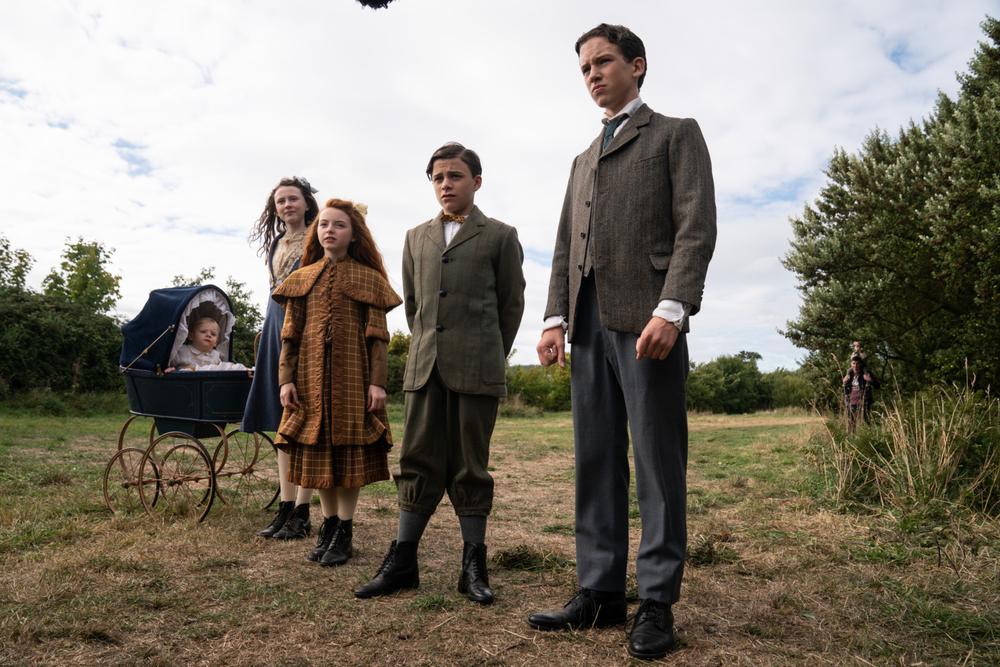
Each child has a unique perspective on their character concerning the family situation, one that wants to reunite her mum and dad, one that recognises their parents are not in love and wants to move forward, one that wants to run away and live with her father, and one that simply wants everyone to be happy. The tension in the two broken families is reasonably well-considered, allowing each child an opportunity to put forward their perspective.

Four Kids and It attempts to provide some more mature themes to appeal to adult audiences, but the sexually promiscuous nature of the two parents, or Brand throwing about phrases such as "ethnically insensitive erotica", does little to make this a film that will hold wide appeal. 

With mediocre computer-generated effects on display, this is a film that will only really appeal to the under-8-year-olds who will be wowed by the concept of being able to fly or have superpowers. Nothing of consequence really seems to happen, and while the story lacks any depth, it will pass some time for the younger ones.

Four Kids and It is in cinemas from September 24, 2020
Originally posted to: https://djin.nz/Kr8711

SAVAGE (2019)

 
Inspired by the true stories of New Zealand's street gangs across 30 years, Danny is shown at three defining moments in his life as he grows from a boy into the violent enforcer of a gang.

Sam Kelly's feature film debut, Savage, attempts to portray the savagery of New Zealand gangs. While it certainly makes itself a bottomless vessel of tension and anxiety, the savagery is somewhat scarce in its authenticity and realism. Not dissimilar to a mask, Savage, is a dissection of the root causes of gang formation, and the eventual contradictory nature of their brand of "family".


Focused around the Savage enforcer, Danny is known by many names; nowadays living under the monikers 'Damage' or 'Sarge'. The film takes us through three pivotal stages in his life that led to questioning his loyalties. A scowling tattooed man with "kind eyes", our protagonist lacks the unstable chaotic nature of Once Were Warriors Jake the Muss; Danny is not content in his position amongst the Savages. Having been the caring, responsible child who would put themselves in harm's way to protect his siblings, his transformation into a weapon for another person's cause, is leading to much unease. More along the lines of this year's Irish drama, Calm With Horses, Savage wants to bring to light the shades of grey in a seedy underworld that many consider black and white.


Somewhat of a double-edged sword, Danny (portrayed by Jake Ryan) isn't a big talker. It cements his position as nothing but a protective force to his leader and co-founder Moses (Haanz Fa’avae-Jackson); an object to be used, and a friend to none. On the flip side, it means his character lacks any sense of charisma. With very few opportunities to see how 'Damage' would act in normal circumstances, it reduces the impact of the more criminal activities as the film consistently shows him using excessive force. With the simple goals of having some money and some friends and family to spend time with, Danny has found himself constantly at the receiving end of abuse; physical, emotional, and sexual. He cherishes the concept of family and being a protector in his own head, but every person he comes across simply wishes to use and discard him, coercing him in a direction that he does not care for.


Gritty and grounded, Savage knows its subject matter well. There is no exposition or detailed monologues or dialogues about people's feelings; emotions are conveyed through actions and mannerisms; through posturing, violence, and expletive language. Such is the way in which these impoverished communities have been cast out by conventional society. Still, the flashbacks that explain Danny's history mean there is little time spent on the present storyline. Danny being the source of violence in the film, sets the standard for the authenticity and genuine nature of the violence, and the flashbacks undermine the integrity of his savage nature.


The film is well shot, with well-designed production sets showing off the degraded living conditions that the gangs have come to call home. However, this lack of integrity, combined with underdeveloped supporting characters create a final product that is full of violence and tension, but never fully feels real. It makes you hold your breath and feel uncomfortable, but the out-of-frame violence doesn't have the gravitas or lethality to leave a lasting impact. Like a blunt knife, or a table with its edges rounded, Savage is a much safer film; less likely to trigger the audience than Once Were Warriors.


As far as providing an explanation as to how inequality leads to gang culture, Savage does a brilliant job; looking at issues within the family unit, as well as those within the governmental institutes that are supposed to protect children. On the more character-driven side of things, Sam Kelly's debut is lacking, which is unfortunate. There was an opportunity here for something truly memorable.

Savage is in cinemas from September 10, 2020 

THE QUARRY (2020)

After murdering a travelling preacher, a fugitive drifter assumes his identity and becomes the new cleric of a small-town church. While he wins over the congregation, the police chief starts to link the mysterious stranger to a criminal investigation.

Directed and written by Scott Teems, with Andrew Brotzman sharing the screenwriter credits, The Quarry is a film adaptation based upon the novel of the same name by Damon Galgut, with a change in happenstance from a pursuit across rural South Africa to a meander through a rural backwater town in the Southern States of America.


The change in location works well with a more recognisable brand; White Male vs Mexican racism. The Quarry is by all definitions a slow and measured piece, that attempts to build stakes in this cat-and-mouse story, through character development and racial drama rather than fast-paced action sequences. With exceptional acting performances from the mouse, Shea Whigham, and the unknowing cat, Michael Shannon, The Quarry manages to hook you into the story despite underutilized characters and little development of the population outside of the main cast.


Shea Whigham is credited simply as "The Man", and is a dangerous man with a complicated past, at wit's end, with no plan in place, simply ignoring obstacles until collision is imminent. Seeking an escape, The Man finds himself in the role of an English-speaking church minister, in an area that primarily does not speak English. His foil comes in the form of Police Chief Moore, whose racism is so overt that he refers to those he is meant to protect as "bugs" and "mud" to be swept off of the streets.


In what should have been a simple open-and-shut case, Chief Moore's hatred and disdain for the non-white community allows The Man an opportunity to avoid punishment for his indiscretions and an opportunity for redemption, but at the cost of another. The Quarry attempts to open discussions around the positions of power that these two white men hold; as the towns head of Police and head of religious affairs, looking at the similarities and differences in how they use and abuse that power.


Chief Moore considers himself a representative of the law, but has no love for the people of his community, using them to satisfy his own needs as long as he can exert his power over them, unable to distinguish between a difference in class and skin colour. Somebody who yearned for the adoration that traditionally came with the role, but was unwilling to provide the care and humility that generates it. The Man, on the other hand, finds himself in a role that he is literally unprepared for, and his ignorance of the material is misconstrued as speaking without judgment, something that instantly earns him a positive reputation with the oppressed community. Both men, operating under a false identity in one way or another, walk side-by-side as the film progresses, unwittingly separating one plot into two, as a consequence of cynical racism.


In the same way that an empty room allows a buyer to imagine the room filled with their own belongings, the preacher's ignorance forms a monotonous sermon that his congregants are able to imbue with their own meaning and interpretation, while at the same time allowing the preacher a moment to contemplate his own position and history. Consequence, guilt, and forgiveness are the crux of The Quarry, but with a truncated 98-minute runtime, proper development of the community that would be necessary to effectively increase the stakes is unable to occur.  Even the main cast finds their character's complicated pasts are teased and alluded to, but never fully fleshed out


The only character that understands the reality of both men, is that of Valentin (played by Bobby Soto). The player that should be able to easily change the course of the plot, but is held back by metaphorical and literal chains, achieves the poignant purpose of reminding the audience that the law doesn’t always serve those who need it the most.


Visually, the environments are beautiful, with minimal yet effective set designs. Michael Shannon and Shea Whigham bring weight to their performances, which form an enticing element to the film. It isn't enough to carry the final act, but everything leading up to it is more than enough to warrant a viewing. 

The Quarry is in cinemas from September 10, 2020
Originally posted to: https://djin.nz/Kr8690

BECKY (2020)

Spunky and rebellious Becky tries to reconnect with her father during a weekend getaway at a lakefront house. But the trip soon takes a turn for the worse when convicts on the run, led by the merciless Dominick, suddenly invade the home.

As soon as I saw this film was about escaped convicts at a lakehouse, I had flashbacks to when I was eight years old watching an at-the-time scary thriller called Firestorm. Nostalgia is a pain sometimes, as Becky was unable to bring that same level of adrenaline and excitement. Of course, it is not fair to compare two different films, especially when they are on two completely different ends of the spectrum with regard to budget and scale. That being said, Becky only scratches the surface of its own potential. 


When you look at the cast, Joel McHale and Kevin James are a surprising choice for the film. Both are playing against their usual typecast role, James going to the furthest point; from a silly, comedic protagonist to the sullen, racially bigoted antagonist of the film. Unfortunately, due to some lacklustre scriptwriting from trio Nick Morris, Lane Skye, and Ruckus Skye, these unlikely roles aren't taken advantage of. 


There are so many cases of comedians having Oscar-worthy performances when they take on more dramatic roles; such as Seth Rogen in Steve Jobs, Jim Carrey in Eternal Sunshine of the Spotless Mind, Steve Carell in Foxcatcher, or Robin Williams in One Hour Photo and Insomnia. Comedians, while often known for overexaggerating and being over-the-top in their performances (especially when physical humour is involved), excel at serious and dramatic roles thanks to their superior understanding of the emotional context of a scene. While I have literally hated everything I have ever seen Kevin James do (Pixels, Paul Blart: Mall Cop, I Now Pronounce You Chuck And Larry, Grown Ups, The King Of Queens), simply seeing James taking on a serious role with a shaved head and full beard...it gave me hope. Hope that didn't quite pan out.


While the likes of Robin Williams and Jim Carrey can easily portray joy and happiness, they can also switch on a dime towards something darker, and more sinister. James simply doesn't have the same effect. Everything that raises red flags and tells you that he is the antagonist comes from his appearance (tattoos), instead of coming from his actions. Where there was an opportunity to really delve into what made his character a bad person, James is a soft-spoken antagonist that delegates anything "evil" to his minions, whose pep talks would fit better if he was a bear (a hairy, heavy-set gay or bisexual man). There is nothing overwhelmingly threatening and without a strong antagonist, the film lacks the proper stakes for this thriller.


What it does do, on the other hand, is allow LuluWilson to take the spotlight. You may recognise her from The Haunting of Hill House, Annabelle: Creation, Ouija: Origin of Evil, and Deliver Us From Evil, but in Becky, she is completely at home. Becky is a 13-year-old with pupils so dilated that her entire aura reeks of "medicated to compliance". As you would expect with any scenario involving someone who has medication withheld, her behaviour becomes increasingly aggressive and unstable as we reach the tipping point, where all hell breaks loose. Again, the script gives very little room for character development, and while Becky is the highlight of the film, we never get to see a full transition from one state to the other. 


Greta Zozula's cinematography is competently crafted, with an almost hazy desaturated filter that juxtaposes the warmth of a family trip to the lake house, and the coldness of premeditated murder and assault. The colour palette and direction are well executed, but it isn't enough to overcome the weaknesses of the script. Underdeveloped characters all-around mean anyone could be churned out as meat for the grinder in this gritty, gory thriller, but it is a double-edged sword as it also means you don't care if any of them die as you don't connect with them.


There is a fair amount of gore in Becky and it works well to keep a level of intrigue and excitement as the film progresses, but there are certainly some scenes that feel extraneous and out of place; as if it was put in simply to fill in time, with no effect on the storyline at all. Becky exists as a film because of its MacGuffin (is an object, device, or event that is necessary to the plot and the motivation of the characters, but insignificant, unimportant, or irrelevant in itself). How the MacGuffin gets where it is, is unknown. What it does is never explained. Why people are willing to kill or die for it is unknown. Is it a weapon, a vehicle, documents, or money? Any explanation would raise the stakes, but the unknown nature means this lakehouse horror story is unlikely to go any further than that.


A fun premise that had the opportunity for some established actors to stretch their wings and excel in a new field, but the script keeps them chained down in this serviceable, but underutilized story. Still worth a watch; go in with low expectations, and you'll be pleasantly surprised.

Becky is in cinemas from September 17
Originally posted to: https://djin.nz/Kr8704

PAPI CHULO (2019)


After a newly-single TV weatherman is put on leave following an on-air meltdown, he directs his energy into home improvement and hires a middle-aged Latino day labourer named Ernesto to help. Despite a language barrier and having nothing in common, the two men develop an unexpected but profound friendship.

Every time I see Matt Bomer, for a split second I confuse him with Henry Cavill. Their facial structures are incredibly similar, but all you have to do to tell the difference is wait and see how happy they are, because Bomer always seems to have a more positive outlook, whereas Cavill is the stern and surly Man of Steel that we have come to look or hate, and has carried that stoic nature into the majority of his other roles.


Bomer is great at playing the happy guy, and in 
Papi Chulo (which translates to Pimp Daddy from Spanish) Bomer plays Sean, a weatherman, that is trying to overcome a loss; in this case, it is a former partner that no longer answers his phone calls, no matter how often he drunkenly calls. When one action forces another, Sean is led to engaging the services of Ernesto, and comedy ensues. Papi Chulo is an effective minimalist dramedy a portmanteau of comedy and drama), with Bomer's Sean and Alejandro Patino's Ernesto taking up the bulk of the screentime. 


Every element is well-thought-out and executed, from things as small as the subtitles. Sean and Ernesto speak English and Spanish respectively, with very minimal cross-over, and the audience is allowed to walk in Sean's shoes by not providing subtitles when Sean and Ernesto "converse". Every time Ernesto speaks, we are just as much at a loss as to what he is saying, as Sean is. There are certain moments where Spanish-speaking people are talking together, and because they fully understand each other (and the conversation is plot-significant), we are provided with subtitles for context. But as a rule, if Sean is present and doesn't understand what is being said, neither does the audience.


Bomer's performance is magnificent. While he initially looks like an arrogant flamboyant gay weatherman, who cares about nothing but harassing his ex and finding other young men to flirt with, Bomer expertly inserts a hidden pain into every smile and laugh. You can sense when the emotions being conveyed are over-dramatic and false, and while it appears like poor acting at first glance, there is a heart-wrenching reason behind it, and Bomer goes all-in. the emotional weight is not toned back for a wider mainstream appeal, neither are violent or insecure moments hidden. Eventually, all is revealed; the good, the bad, and the ugly.


His third attempt at writing and directing a feature-length film, director John Butler utilizes that control over the material effectively. his time has not been split between the two roles, the two roles have combined to truly create the vision that he has, and the narrative direction of the film is clear from the outset. It leads you in a certain regard, and some may consider that predictable, but while the events are predictable, Sean's reactions to the events are volatile and erratic because of his poor mental state.


The cinematography from Cathal Watters is compelling. Never flashy enough to distract from the emotional development of the characters, Watters creates a warm, bright environment when Ernesto is with Sean, compared to the darker, flatter environments when Sean is alone. The musical composition from John McPhillips is also inconspicuous and unobtrusive, lifting the material without ever truly making you aware of its presence.


Papi Chulo goes much deeper than what you would expect. It is in no rush to find a happy ending and will let every ounce of desperation and fear hold the viewer in suspense. Patino and Bomer work brilliantly together and the connections, contrasts, and conflicts of their budding friendship blossom into a surprisingly engaging film (about a man hiring a Mexican to paint his deck). 

Papi Chulo is in cinemas from August 27, 2020

DOUBLE - A Darkfield Radio Experience


As COVID-19 continues to disrupt the arts industry across the globe, innovative UK company Darkfield are launching in New Zealand with their visionary new audio experience DOUBLE, opening Tuesday 1 September. Brought to Aotearoa by Australia's Realscape Productions, DOUBLE will allow Kiwis to take part in a critically-acclaimed, chilling, and immersive encounter within their bubbles, regardless of the country's COVID alert level status. All you need is a mobile device, headphones - and a friend...

There is no easy way to describe what I have just experienced. To sit at a kitchen table across from someone, look at them, then close your eyes for twenty minutes as an apps audio plays havoc with your senses. The structure alone of this experience is unnervingly unique. Recreating that feeling of sensory deprivation that you may have experienced while playing on a Virtual Reality set; where blocking your visual field allows you to be transported somewhere now, no longer aware of the dimensions of your actual location.

Darkfield Radio has formed a scintillating and chilling experience that temporarily leads to unease, anxiety, and distrust of the person sitting directly opposite you. A person you know incredibly well...or do you. The experience plays with reality, using the unknown to twist your perceptions about elements you were previously confident about.

The audio is incredibly well-produced, with a storyline that turns from a soothing delve into your own interpersonal relationships, and spirals out of control down a rabbit hole of uncertainty. The quality of the audio cannot be downplayed. this is not a simple left and right stereo experience. This is a cinematic 360-degree adventure of unanticipated--but welcomed--depth; all with your eyes kept firmly shut.

DOUBLE calls for the best over-the-head headphones that you can procure, and I would even go as far as to recommend a sleeping mask too if you have one. Something that will allow you to sit in the darkness, with no visual or aural stimuli from your direct surroundings beyond your memory of them. While it will work fine with earbuds and your eyes closed, the experience works best with as little background noise as possible.

So difficult to explain without ruining the experience, the knowledge that the person sitting opposite you is receiving different audio, it plays with your mind, and the aural display starts to affect your other senses. The shadows in your mind's eye start to move, and your grasp of what is real and what is fabricated begin to blur.

DOUBLE is exquisite. A must-experience performance that will leave you breathless and covered in goosebumps. As for what you can expect in terms of content? All I can say is, don't leave your glass of water too close to the edge of the table... A cinematic performance for the mind that will have you absolutely yearning for more.

DOUBLE opens Tuesday 1 September 2020.
Session times: Tues, Thurs, Fri and Sat at 8pm, 10pm and 11pm.
Tickets are available via the Darkfield website
Price: $10

LOWDOWN DIRTY CRIMINALS (2020)


Best buddies Freddy and Marvin naively think a life of crime will be glamorous and rewarding, but when they mess up a simple job for their new boss, the hilarious and violent consequences spiral out of control!

There was a clear attempt to create something exciting. To recreate the quirky comedy and gratuitous violence and insanity of Guy Ritchie's Snatch or Lock, Stock and Two Smoking Barrels, with the small world vibe of New Zealand. Lowdown Dirty Criminals falls short of the mark; a 90-minute feature film that feels more like a spinoff of Outrageous Fortune than it's own well-developed piece.


Lowdown Dirty Criminals stars a veritable ensemble of familiar faces; from Boy's James Rolleston, Packed To The Rafters' Rebecca Gibney, Scott Wills from Underbelly NZ: Land Of The Long Green Cloud, to Robbie Magasiva from Sione's Wedding, and Cohen Holloway (What We Do In The Shadows, Hunt For The Wilderpeople, Thor: Ragnarok, Eagle Vs Shark). This is as kiwi as you can get in terms of cast, but is also very kiwi with how it caters to the lowest common denominator in terms of its comedy stylings.


This has such a quintessential kiwi look and feel to it, that you want it to succeed; you are willing this to be another international hit like Hunt for the Wilderpeople or What We Do In The Shadows. What we have, however, is something that feels like an exaggerated broadway play that has had its timeline switched around to make the story feel more exciting. Every character is completely one-dimensional and has an over-the-top flair for the dramatic. Excessive to the point that a child watching the tv through a window from across the street will still know exactly what is going on. There is no room for subtlety here. 


The humour itself is enjoyable if you are young enough. Everything is either a visual or a physical gag; look how crazy he looks! look how overweight that man is! ew! is he watching porn? There are no deep meanings or hidden contexts in Lowdown Dirty Criminals, everything is spelt out by the antagonists and protagonists but misunderstood by each other, which leads to the gratuitous unnecessary violence. Why are they incapable of properly communicating? Because if they could, the film wouldn't exist. 


Initially, it all catches your interest. It's pretty fast-paced and wacky, but as the film progresses, it becomes clear that there is no real story, the protagonists have such little development that you don't care what happens to them, and even as the blood and gore step up, as an audience member it all stops registering or garnering a reaction. In this manner, you could compare Lowdown Dirty Criminals to one of Daniel Radcliffe's latest films (which coincidentally was also filmed in New Zealand), Guns Akimbo, which fetishized the physical and toilet humour along with gory violence. 


The soundtrack works quite well, with some great tracks from kiwi greats Collision, Gin Wigmore, Supergroove, and even young heavy metalheads Alien Weaponry get two tracks on the soundtrack. All of this Kiwiana adds to my disappointment at the conclusion of this film. It was kiwi cast with kiwi music, shot in kiwi-land, but the script is so weak that it feels as if they have dumbed it down. It's condescending enough to say that we made this for you from all your stuff, but we will spell out everything and make the story really basic, otherwise, we don't think you'll get it. 


I watched it, I laughed a few times, and I cringed a few times, but by the end of the film, the non-linear narrative was more annoying than joyful, and there were insufficient stakes built up to make for a satisfying final act. On the wrong side of the comedy/satire line, Lowdown Dirty Criminals can't be taken seriously at all, so all threats of violence and ultimatums, end up having no effect at hooking the audience in. You can have comedy, but you need to properly develop your characters and validate the threats. None of that has happened here. 

Save this one for when you are under the influence; you'll love it then.

Lowdown Dirty Criminals is in cinemas from August 20, 2020